Dongguan is one of China’s most important garment manufacturing hubs, especially for knitwear, casual wear, workwear, children’s clothing, and fast-fashion apparel. Its advantage is not only a dense supply chain, but also the availability of factories that can handle sampling, small-batch production, and larger export orders. However, the market is highly fragmented. Some suppliers are genuine manufacturers, while others are trading companies or small workshops with limited quality control. Finding a reliable factory therefore requires more than comparing prices; it requires verifying production capability, compliance, communication, and after-sales support.
The first step is to define your product requirements clearly. A factory that is strong in men’s workwear may not be suitable for delicate women’s dresses, just as a knitwear specialist may not handle woven coats well. Before contacting suppliers, confirm your product category, fabric type, target price, order quantity, quality standard, packaging requirements, and delivery timeline. If you need OEM production, prepare tech packs, measurements, and reference samples. If you need ODM support, ask whether the factory can develop patterns, source fabrics, and provide seasonal styles. Clear requirements help filter out unsuitable suppliers early and reduce misunderstandings during sampling.
The next step is choosing the right sourcing channel. General B2B platforms such as Alibaba, Made-in-China, and 1688 are useful for finding many suppliers quickly, but they should not be treated as proof of reliability. Business licenses and platform badges can help, yet they do not guarantee production quality or on-time delivery. Vertical garment platforms and industry-specific sourcing channels can improve matching efficiency because they focus on apparel categories, order types, and factory capacity. Offline channels remain valuable as well. Trade fairs in Guangzhou and the wider Pearl River Delta allow buyers to meet factory representatives, check samples, and assess professionalism in person. Visiting industrial clusters in Dongguan, especially in Humen and Dalang, can also reveal factories that do not actively market themselves online.
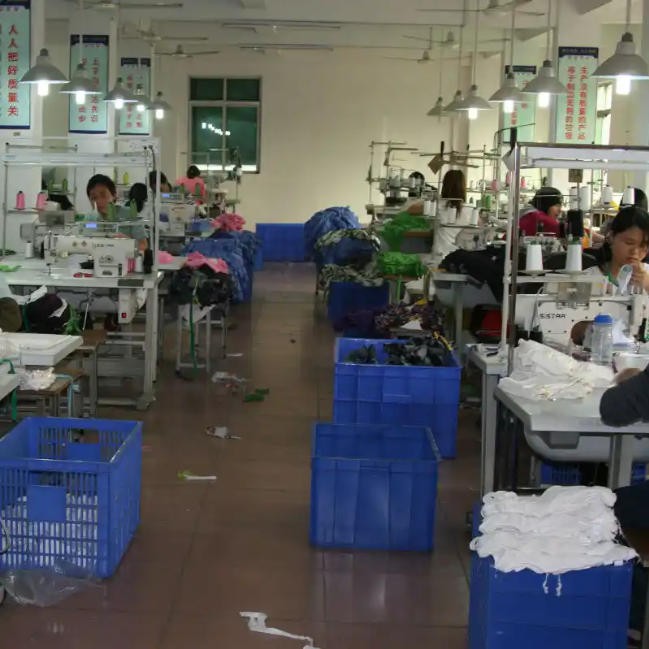
After building a shortlist, verify whether the supplier is a real factory. Ask for the full company name, factory address, business license, photos of the production floor, and a video call tour. If possible, arrange an on-site visit. During the visit, check whether cutting, sewing, finishing, and inspection are handled in-house or outsourced. Factories that outsource many processes without clear control may struggle with consistency. Pay attention to equipment condition, worker skill levels, fabric storage, sample rooms, and whether there is a dedicated quality control team. A clean, organized workshop is not a guarantee of quality by itself, but poor housekeeping often signals weak management.
Quality control capability is critical. A reliable garment factory should have clear procedures for fabric inspection, cutting accuracy, in-line inspection, final inspection, and defect handling. Ask how they control color shading, measurement tolerance, seam strength, needle detection, and packaging accuracy. For export orders, confirm whether they can follow AQL standards and cooperate with third-party inspections from companies such as SGS, BV, or Intertek. Always request a pre-production sample and a sealed reference sample before mass production. Do not approve bulk production based only on photos or low-price promises.
Compliance verification is equally important, especially for buyers serving Europe, North America, or large brands. Many international buyers require social compliance audits such as BSCI, Sedex, WRAP, or brand-specific factory audits. Environmental compliance matters for factories involved in washing, dyeing, printing, or other wet processes. Quality management certifications such as ISO 9001 can indicate systematic production control, but they should be checked together with actual audit reports and recent customer references. If a factory claims to have passed an audit, ask for the report number, audit date, and scope rather than accepting verbal assurances.
Pricing should be compared carefully. An unusually low quotation often means lower fabric quality, simplified inspection, rushed workmanship, or hidden charges. Ask for a detailed cost breakdown, including fabric, trims, labor, printing or embroidery, packaging, testing, and freight. Confirm the minimum order quantity, sample fee, mold or pattern fee, payment terms, delivery schedule, and responsibility for defective goods. A professional factory will usually ask detailed questions about your product instead of immediately offering the lowest price.
Communication is another practical indicator of reliability. Responsive suppliers who confirm specifications in writing tend to be safer partners. Keep all important details in emails or platform messages, including approved samples, measurement charts, label content, packaging marks, and delivery deadlines. For first cooperation, start with a small trial order to test quality stability, lead time, and problem-solving ability. If the trial order succeeds, gradually increase volume rather than placing a large order immediately.
In summary, finding a reliable garment processing factory in Dongguan depends on disciplined sourcing. Define your product clearly, use multiple channels to find suppliers, verify factory identity, evaluate quality and compliance systems, compare total costs, and protect the relationship with written confirmation and trial orders. Dongguan has strong manufacturing depth, but the best factory is not always the largest or the cheapest. It is the one that matches your product category, order size, quality expectations, and delivery rhythm.
 Factory
 Factory